Skip to content
Gbenga AwojinrinContact
Menu

PhD student, Petroleum Engineering · Texas A&M University

Gbenga Awojinrin

I work on machine learning and numerical methods for simulating flow underground, and on testing when a learned model can stand in for a classical reservoir simulator.

Waterflood SPE10 Model 2, layer 3 (Tarbert)

SPE10 Model 2, layer 3 (Tarbert): water saturation after 1.20 pore volumes injected, with water (blue) swept from the central injector through the more permeable rock toward the four corner producers.I1P1P2P3P4

STEP 60/60 · 1.20 PVI · NEWTON ≤ 5 · max residual 3.9e-10 · water cut 95% · recovery 27%

water cutoil recoveredoilwater

Water injected at the center (I1) sweeps through the rock toward four corner producers. Simulated when this site was built; drag the slider or point at a cell.
Simulation notes

SPE10 Model 2, layer 3 (Tarbert): 60 × 220 cells of 20 × 10 ft, permeability 0.004 to 20,000 mD, from the lilq-pinn repository (benchmark by Christie and Blunt, 2001). The well pattern is SPE10 Model 2's. Finite-volume pressure and implicit upwind transport, each cell's saturation solved by Newton's method. The relative permeabilities and the water and oil viscosities (0.3 and 3 cP) are the benchmark's; porosity of 0.2 everywhere and incompressible flow are simplifications.

Latest

  1. Released version 2.0.1 of lilq-pinn, the open-source code behind LiL-Q, with an archived copy on Zenodo.

  2. Presented LiL-Q at AESCAPE 2026 in Dallas, a conference on AI for engineering simulation.

  3. Our paper applying LiL-Q to reservoir simulation appeared in the ECMOR 2026 proceedings.

Earlier updates (3)
  1. Passed the PhD qualifying exam and started the PhD in the same group.
  2. Graduated from Texas A&M with an M.S. in Petroleum Engineering.
  3. Posted the LiL-Q methods paper on arXiv.

Profile

I'm a petroleum engineer and a first-year PhD student at Texas A&M University, in the Computational Reservoir Engineering group. My research asks how to make physics-informed machine learning fast and dependable enough to be useful for reservoir simulation.

Physics-informed neural networks are slow to train and often fail to converge, because their training is a nonconvex optimization problem. My main project, LiL-Q, removes both sources of that nonconvexity, the nonlinear physics and the network's own nonlinearity, so training becomes a short sequence of least-squares solves. It was my M.S. thesis, the methods paper is on arXiv, and the code is open source. I compare these methods with finite-volume solvers on the same problems, to show where a learned model is worth using and where it is not.

I trained as a petroleum engineer at the University of Ibadan, where my undergraduate research applied machine learning to drilling and production data. At Texas A&M I am also a teaching assistant for PETE 301, Numerical Methods in Petroleum Engineering, co-chair internal outreach for the Energy Research Society, and volunteer with SPE's Data Science and Engineering Analytics technical section.

Research

  1. 2026

    Preprint

    A Convex Quasilinearization Method for Solving Nonlinear PDEs with Physics-Informed Neural Networks

    Recasting physics-informed training as a short sequence of least-squares solves made it converge in a handful of iterations on seven benchmark problems, from Burgers to 3D Navier–Stokes.

    G. T. Awojinrin, A.-A. Olawoyin, R. M. Younis. arXiv preprint 2606.18175

    Read the paper
  2. 2026

    Conference paper

    Quasilinearized and Convexified Physics-Informed Neural Networks for Reservoir Simulation

    Applied to reservoir problems, including SPE10 permeability, LiL-Q converged in a handful of iterations where standard physics-informed training took hundreds to tens of thousands of steps, though finite volume stayed faster.

    G. Awojinrin, H. Tan, R. Younis. ECMOR 2026, European Conference on the Mathematics of Geological Reservoirs, Porto

    Read the paper
  3. 2024

    Conference paper

    Production Forecasting in Gas Lifted Wells using Interpretable Machine Learning Techniques

    S. O. Isehunwa, G. T. Awojinrin, P. Oluwatayo. SPE Nigeria Annual International Conference and Exhibition, Lagos

    Read the paper
  4. 2022

    Conference paper

    Machine Learning Workflow for the Determination of Hole Cleaning Conditions

    G. T. Awojinrin. SPE Annual Technical Conference and Exhibition, Houston

    Read the paper

Projects

Ongoing · 2024–present

LiL-Q: convex training for physics-informed models

Recasts physics-informed neural network training for nonlinear PDEs as a short sequence of linear least-squares solves, removing the nonconvexity that makes standard training slow and unreliable. Tested on seven benchmark problems and on reservoir flow, against neural-network and finite-volume baselines.

  • Single-digit outer iterations on seven benchmark PDEs
  • Runtimes up to three orders of magnitude shorter than standard physics-informed training
  • Open-source code with a reproduction guide, archived on Zenodo

Lead developer, M.S. thesis and PhD research
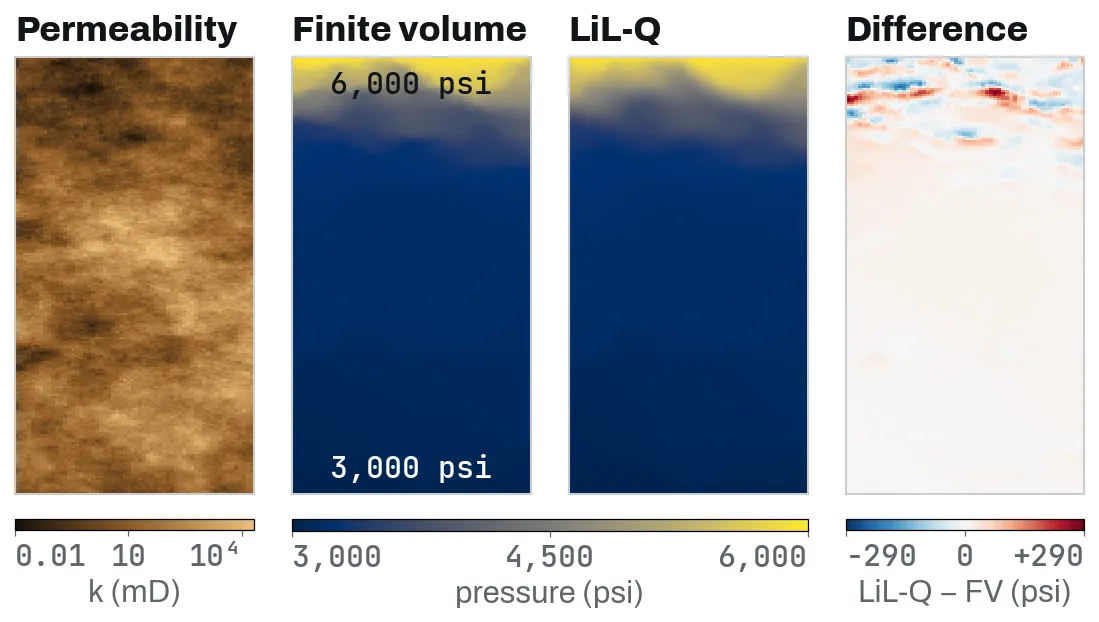
Four tall panels of the same 1,200 by 2,200 ft field. The first shows permeability, with tighter rock in the upper part. The second and third show pressure from finite volume and from LiL-Q, nearly identical, rising from 3,000 psi at the bottom to 6,000 psi in a band below the top edge. The fourth shows their difference, near zero over most of the field, with patches of up to about 280 psi of either sign in that top band.
Pressure on SPE10 Model 2, layer 3, held at 6,000 psi along the top and 3,000 psi along the bottom. LiL-Q, one least-squares solve for 3,169 coefficients, differs from the finite-volume reference by 27.3 psi RMS, mostly in tight rock below the top edge. Drawn from the public lilq-pinn results.

Completed · 2022

Predicting hole cleaning from surface data

Trained ensemble machine-learning models on published flow-loop experiments to predict the concentration of drilled cuttings in deviated wells from surface drilling parameters. The paper won the 2022 SPE Africa regional student paper contest.

Undergraduate research, University of Ibadan

Drilling · Machine learning · Ensemble models

Completed · 2022–2023

Production forecasting in gas-lifted wells

Built interpretable machine-learning correlations from field production data to forecast oil rates in gas-lifted wells and compare gas lift with natural flow. Undergraduate thesis at the University of Ibadan, published at the 2024 SPE Nigeria Annual International Conference.

Undergraduate thesis

Production engineering · Interpretable ML

Talks

  1. Quasilinearized, Convex Physics-Informed Neural Network Training for Nonlinear PDE Simulation

    AESCAPE 2026, AI-Empowered Simulations & CAE Applications via Engineering Software 2.0 and 3.0 (USACM), Dallas, Texas

  2. Fast PINNs: Quasilinearization and Linear-in-Learnable Architectures

    Computational Reservoir Engineering (CoRE) Annual Industrial Affiliates Meeting, Conroe, Texas

  3. Hybridizing Newton's Method with Physics-Informed Machine Learning: Towards Efficient Methods for Nonlinear Simulations

    9th Texas A&M Conference on Energy, College Station, Texas

  4. Machine Learning Workflow for the Determination of Hole Cleaning Conditions

    SPE Annual Technical Conference and Exhibition 2022, Houston, Texas

  5. Implementation of a Machine Learning Workflow for Predicting Cuttings Concentration in Deviated and Horizontal Wells

    SPE Nigeria Students' Technical Symposium and Exhibition (third place, student paper contest), Warri, Nigeria

Experience

Research and industry

  1. Graduate Research Assistant, Computational Reservoir Engineering (CoRE) group

    Aug 2024–present

    Texas A&M University · College Station

    Develop LiL-Q, a convex training method for physics-informed models of nonlinear PDEs, and test it against neural-network and finite-volume baselines.

    • Cut training runtimes by up to three orders of magnitude against standard physics-informed training on nonlinear benchmark problems.
    • Released the code as the open-source lilq-pinn package, with a guide to reproduce every result.
    • Applied the method to reservoir simulation in a paper in the ECMOR 2026 proceedings.
  2. Well Construction Intern

    2021–2022

    SLB · Port Harcourt

    Supported the maintenance and deployment preparation of MWD and LWD tools at the operations base, and proposed a project to mechanize a manual pumping procedure.

  3. Operations Intern

    2021

    Alpha Oilwell Technologies · Port Harcourt

    Inspected, calibrated and checked wireline and slickline tools before well-logging jobs, and moved the company's filing system from paper to electronic records.

Teaching

  1. PETE 301, Numerical Methods in Petroleum Engineering

    Fall 2025 and Fall 2026

    Graduate teaching assistant · Texas A&M University

Leadership and service

  1. Operations and Tech Lead

    Sep 2026–present

    SPE Data Science and Engineering Analytics Technical Section

    Volunteer on the technical section's team, looking after operations and technology for its program of events.

  2. Internal Outreach Co-Chair

    Feb 2026–present

    Energy Research Society, Texas A&M University

    Coordinate outreach that connects graduate researchers with the wider student community, including for the student-led Texas A&M Conference on Energy.

  3. PetroBowl Committee Member

    May 2025–present

    SPE Texas A&M Student Chapter

    Help organize and run practice sessions for the chapter's PetroBowl team.

  4. General Secretary and PetroBowl Team Captain

    2021–2023

    SPE University of Ibadan Student Chapter

    Kept records and communication for a chapter of over 200 members and captained its quiz team.

    • Captained the five-student team that won the 2023 SPE Nigeria PetroQuiz, the chapter's first national win in eight years.
    • Organized a month-long chapter quiz tournament as E&P Team Lead and helped relaunch the chapter newsletter online.

Recognition

  1. 2024

    Stephen Oluwole Awokoya Foundation Postgraduate Scholarship

    One of five recipients from 110 nominees, all best graduating students of their universities

  2. 2023

    Energy Leader for Tomorrow

    Energy Intelligence

  3. 2023

    Delegate, IPTC Energy Education University Student Programme

    International Petroleum Technology Conference, Bangkok

  4. 2022

    Winner, SPE Africa Regional Student Paper Contest, undergraduate division

    Society of Petroleum Engineers

  5. 2022

    Third place, SPE Nigeria Student Paper Contest

    Society of Petroleum Engineers, Nigeria Council

  6. 2021/22

    Best Graduating Student, Department of Petroleum Engineering and Faculty of Technology

    University of Ibadan

  7. 2020

    Dr. Olumide Phillips Scholarship

    SPE Nigeria Council

Toolkit

Numerical methods
Quasilinearization and Newton–Krylov methods · Linear least squares (QR) · SVD and conditioning analysis · Chebyshev and Fourier spectral methods · Finite-difference and finite-volume methods
Machine learning
PyTorch (CUDA, automatic differentiation) · Physics-informed neural networks · DeepONet · scikit-learn · Ensemble models
Reservoir engineering
Reservoir simulation · Multiphase flow in porous media · Geostatistics · CMG
Programming and tools
Python (NumPy, SciPy, Pandas, Matplotlib) · C++ · MATLAB · Git and GitHub Actions · LaTeX

Contact